

Reforestation. The pines
Mai 2025
In the 50s and 60s of the last twentieth century, in the midst of the post-war period where the needs were many and the resources few, the Spanish government, through the State Forest Heritage, promoted the reforestation of the common forests so that the people of the villages had work because at that time there was no unemployment or subsidies.

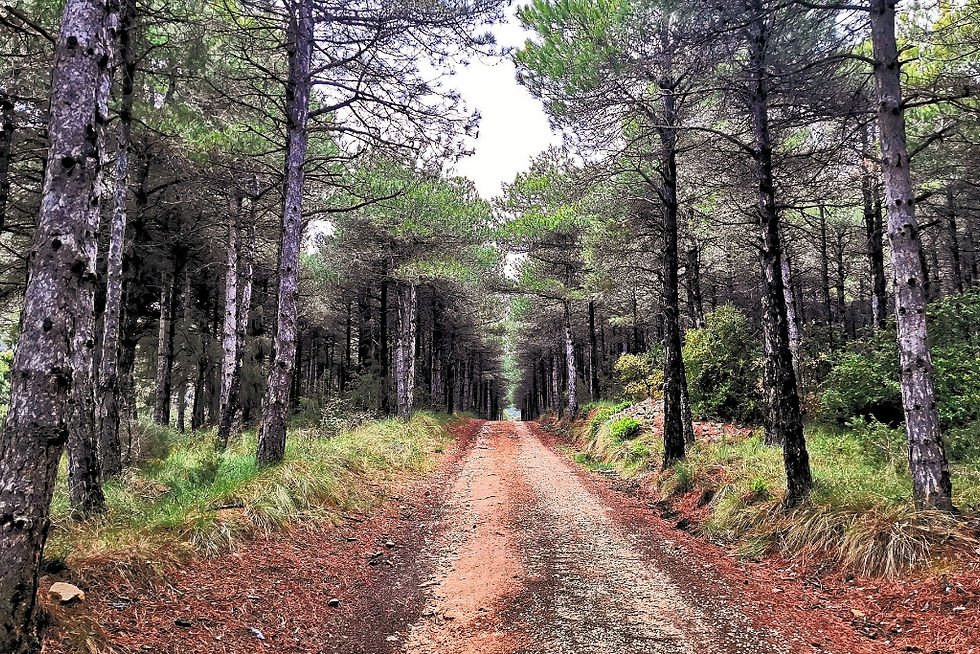
This process also reached our land. In Colungo they repopulated the Sierra de La Cunarda with pines. The forest guard was Ramon López, he had people from Colungo, Asque, Suelves and Bárcabo in the brigade. In Radiquero, the reforestation (which we always called "the pines") began with the arrival of the forest guard Florentino Becerril, a native of Jarque del Moncayo (Zaragoza). It started with El Tito, everyone had to bring their own tools, a pike and hoe, the working day was 8 hours plus almost two hours of going and the same of returning, walking of course.

The work was a 'dry day', which means that each one had to bring their own food. My father and my brother, like other people of the village worked there. There was a little help for the family economy that, added to the resources we had in our homes, allowed us to subsist without going hungry, and this was the same for the most of families in the village.
After the repopulation of Tito, man began to built the track to San Pelegrín by means of many workers with picks and shovels, excavators and any type of machine having not yet arrived. The holes for the blasting of the stone were made by two men, "the drillers", one sitting on the ground and pointing to the hole a very long steel drill standing between his legs, the other man was standing lifting the drill one time after another, dropping it suddenly at the same time as he turned it. Thus, blow after blow, the stone was drilled, although making a hole took many hours. When there were many holes to do, they put dynamite cartridges and proceeded to blow them up all at once, taking care that there was no one in the proximity.

When the work was advancing towards San Pelegrín and the first vehicle was about to arrive, the neighbors were expectant and when it appeared through the crosshead they burst into applause with tears in their eyes and shouts of Long live Spain, tira palante!. It was undoubtedly a historic day for the seven families who lived there. Some time before, the electric light had also been laid. Unfortunately, a few years later most of them abandoned everything in search of a possible better life, leaving behind all the efforts they had made to fix their houses having to carry the materials on the back of horses. It must have been very hard for them.

Later the track was lengthened until it reached the Meson de Sebil (Sebil inn) and when it could be reached with vehicles, the reforestation of this part of the mountain range began. I already participated there. From the age of 15 to 18 I was a helper because I was not old enough to brock the stone, they paid me 8 pesetas an hour (64 a day would now be 40 euro cents), the brockers earned 100 pesetas (now 60 euro cents). They took us up on the truck of Manolo Pardina from Alquezar, he picked up personnel in Alberuela, Adahuesca, Alquezar, Radiquero and San Pelegrín. Every 15 days the paymaster, Teófilo, came with a motorcycle to the pit, it was not mandatory to go every day, the foreman Mariano who was from Adahuesca had previously written down the wages of each one and they paid us in cash.
My work was very varied, the first thing when I arrived was to light a fire to cook the food throughout the morning for those who carried a stew, they used to bring some potatoes with a pinch of meat, bacon or sausage, those who carried a luch box just heated it a little before the lunch time. I had to be aware that there was never a lack of water in the "buyol", which was like a small wooden barrel with a cannula that served as a bottle, when one of those who were chipping wanted to drink, they said out loud "pinche agua" and I brought the buyol to them so that they would not have to move, and again when someone else asked for water. I went to look for the water to one of the fountains closest to the tagus, the Pallas, the Arto, the Toba, the Melsadera, the Teja or even to a ravine because the water was good there. As sometimes I had to go through the forest, the first time I was throwing crop twigs to the ground to be able to return along the same path and not get lost.

Another of my functions was to distribute the pine plant through the holes that made the brockers . Previously someone had brought the plants with a truck in some large baskets, a kind of orchard was made near the pit and I with a basket on my back was carrying the plant as needed. I remember once on Holy Thursday that we worked only in the morning, the foreman sent me to look for a plant early in the morning, it was a sunny day, but it was windy and very cold to the point that when I arrived at the pit, I was frozen, they had to light a fire for me to warm up. Planting a pine tree also had its technique, you had to "apedecar" (press the soil very well against the root), the foreman went to check if they were well planted, he pulled the leaves with his hand and if it was uprooted, it should be planted again.
As an anecdote, I can tell you that when the foreman touched the whistle to finish work, everybody that had the pike upat that moment, let it fall towards his back, not even forward. One of the workers, whom we called Fortuna, had been a shepherd in Suelves, he lived partly in the named "casata de los pobres" (little house of the poor) in Radiquero, partly in the Sebil inn, he had a donkey and a dog, one afternoon his dog ate the bread I was keeping for the afternoon snack and some colleagues gave me theirs. We made the snack on the bus back home, most of the time a slice of bread with a portion of chocolate or a clove of raw garlic that mixed with the bread tasted like heaven.
The reforestation was completed and many of those people continued to work on the construction of the sanctuary of Torreciudad and the Cinca canal. When this was ending, people began to wonder what they would do next, since there were no jobs in sight. One of them who had a reputation for not being a very good worker said to his colleagues "now don't complain, if you had all chipped like me there would have been work for long in the canal ".

Until now, life in these villages was developing normally, but when all this ended and there were no job prospects, the phenomenon of emigration began because they had to eat. Many families, especially with children, abandoned their lands, their homes and closed their doors in search of a life with more opportunities, leaving behind everything their ancestors had built. Hard decisions for everyone, but especially for the children who left their village, their school, their teachers, their games, their classmates, their friends and have to join a city where they know nothing or anyone, a new school, new teachers, new classmates and in some cases the difficulty of having to adapt to another language.

But it was just as sad for those who remained in the village, starting with the feelings of the children who saw how their classmates were leaving little by little and there were fewer and fewer in school to the point of disappearing. The same happened with the elderly when they saw that more and more doors were closed and there were fewer neighbors left. As a consequence of all this, the bad thing was that as the population decreased, some services also decreased or disappeared and the quality of life was no longer the same. In Radiquero before all this, we have a doctor and practitioner, (shared with Alquezar), teacher, two shops, two butchers, tobacconist, barber, town crier, shoemaker, postman, blacksmith, butcher, taxi service, bakery, oil mill, feed mill, lavande distillation, line cars to Huesca and Barbastro every day, the priest went to mass every Sunday and the bell rang, because apart from his pastoral mission he also fulfilled a social work and those of us at Radiquero know a lot about that.
Certainly there had always been emigration, but not as traumatic as the one we are referring to, because the houses were not closed. There used to be many children in families and logically there was not enough for everyone. An heir remained, usually the eldest, but it could be another, thus ensuring the continuity of the house and being the one who took care of the parents and grandparents while they lived. The rest to make a living out of the village, the parents, if they could, would give them something, but generally very little because there was almost nothing. It hurted to have to leave home, I was just another emigrant and at first I had a hard time until I adapted, but the house did not close.

The continuity of the house was considered so important that in some cases there were two married couples living together, the heir and another who called him to over-assets, it was like a kind of reserve in case the first one could have health problems, work disability, death or even lack of children. That way the house would go on.
Part of the problem of emigration could possibly have been avoided if the governments of those times had facilitated the establishment of factories, industries and work centers in small cities and county capitals to fix the population of nearby towns instead of taking everything to the big cities, because no one liked to abandon our roots.
Now we have no choice but to accept what there is, we don't know what would happen tomorrow, because the world has evolved more in the last 70 years than before in 500 years and as a man from Radiquero said many years ago "the only thing it hurts me to die is that I won't be able to see how all this ends".


Comments